TL;DR
- Indonesia wrote crypto rules faster than almost anyone alive, and the market kept shrinking. Rule count up to about 20 by 2026; domestic volume down 26 percent in 2025, the year the world hit new highs.
- 2025 is the tell. The 2022 crash and the 2024 recovery were shared with the world. Only in 2025 did Indonesia break from it, down 26 percent while global volume held and the region grew, the exact year the rules stacked hardest.
- The drag is structural, not the tax rate. Indonesia is lighter on rate than India, Japan, or Korea, but it taxes every trade instead of every gain, bans crypto payments, and stacks instruments with nothing on the other side, while Thailand, Singapore, Hong Kong, and Dubai pull activity in.
- The enemy is performative regulation, not regulation. Good rules grow a market up. Rules written to look busy strangle it.
- What is dying is the copy-paste, not the market. Twenty million registered, demand walked offshore, and the businesses that folded were planted in the wrong soil. The gap between what the rules allow and what people want is the opening.
- The play: hyperlocal context is the moat. Every hard Indonesian market, Komunal, Kopi Kenangan, Fore, was won on local fit, never an imported template. The wider the gap grows, the bigger the prize for whoever closes it.
Indonesia wrote crypto rules faster than almost anyone alive. The rulebook keeps thickening; the market it governs keeps thinning.
I have been watching this build for a while. Last issue it finally resolved into one image: the K-shape, with Indonesia as the leg going down. The gap has only widened since. In 2025, licensed domestic volume fell 26 percent to Rp482 trillion, in a year when the global market printed a fresh all-time high and on-chain activity across the rest of Asia-Pacific grew 69 percent. Seventy-two percent of the country's licensed crypto exchanges ran at a loss. Its global adoption rank slid from the top three to outside the top five. The regulations, meanwhile, kept coming.
Rule count up, market down, and the incumbents who bet on the rules now shouting about how little the rules solved. That is the whole story in one picture.
None of this is an obituary. The widening gap is the entire point, because a market being strangled by its own rules is also one that almost nobody is serving properly, and that is the most interesting kind of market there is.
What the rules were supposed to do
Start with the promise, because every wave of Indonesian regulation carried the same one: rules make a market safe, safety makes it grow up, and a grown-up market attracts serious money. Register the exchanges, whitelist the tokens, tax the trades, hand oversight from the commodities agency to the financial regulator. All of it sold as maturation.
The reality sits in one chart.
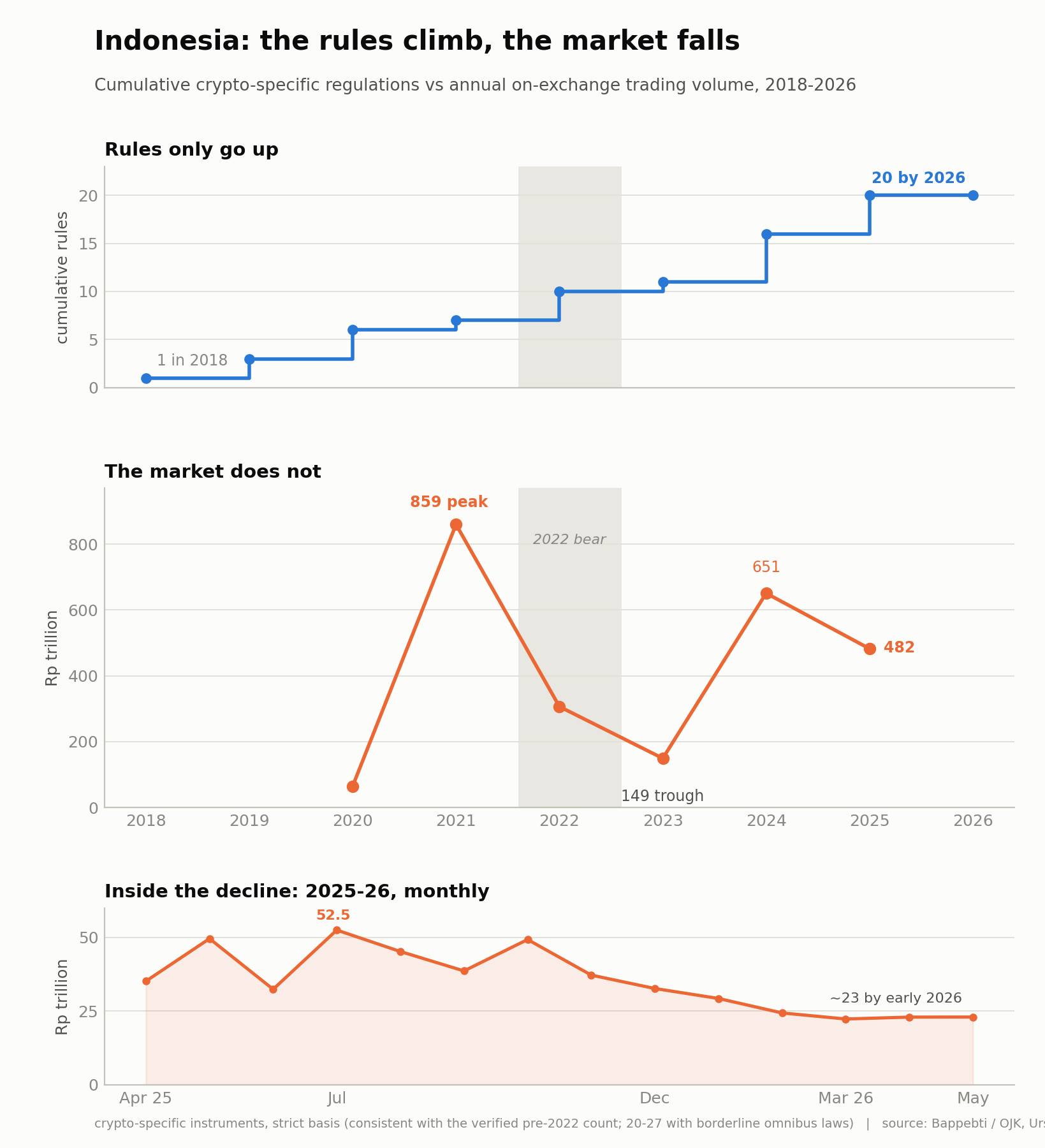
While the rule count climbs without a pause, volume peaks in 2021 at Rp859 trillion, collapses through 2023, and never fully returns.
There is an honest objection to make here, and it is worth making before someone else does. 2022 was a global bear market; everyone crashed, Indonesia harder than most. Then 2024 brought a violent recovery, volume up more than 300 percent, back to roughly three-quarters of the old peak. Through all of that, nothing about the story is specifically Indonesian. It is just the cycle.
2025 is where the cycle stops covering for the rules. The global market set a new all-time high that year, on-chain activity across Asia-Pacific expanded, and Indonesia alone ran the other way, down 26 percent in the exact stretch when the regulations piled up fastest: oversight formally moving to the financial regulator in January, a fresh crypto tax in August, more instruments stacked behind them.
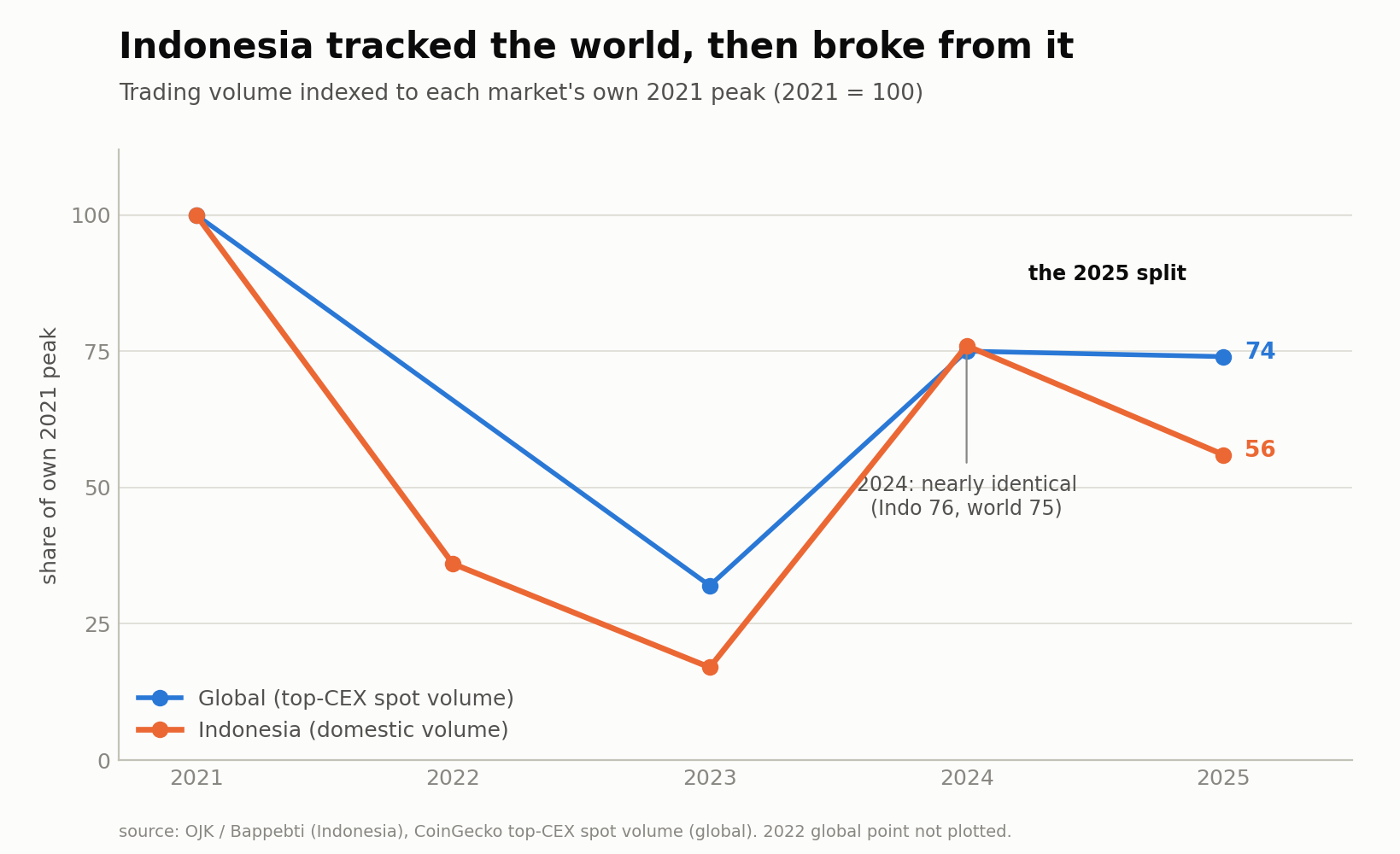
The two markets are nowhere near the same size, so the chart does the honest thing: it pins each to its own 2021 peak at 100, then plots every later year as a share of that. Trajectory, not raw size. Read it that way and Indonesia tracks the world clean through the crash and the 2024 rebound, 76 percent of its peak against the world's 75. Then 2025 splits them: the global line holds, and Indonesia slides back to 56.
When the tide lifts every other boat and yours is the one still taking on water, the problem is the boat. Indonesia's own regulator has been blunt about where the volume went: offshore. The mechanism is not a mystery. Rules that leave most licensed traders unprofitable make for thin domestic order books, and thin books cannot hold users against the deep liquidity on the global platforms next door. So the users left for the liquidity. The August tax was built to pull them back, 0.21 percent on a licensed domestic trade against 1 percent on a foreign one, but the platforms that actually caught the outflow are unlicensed and offshore, outside the tax net entirely. The rules did not kill the demand. They exported it.
First does not mean best
Indonesia was early, and that counted for something real. While most of the world was still arguing over whether crypto was a security, a commodity, or a crime, Indonesia had already called it a commodity, licensed exchanges, and stood up a framework. For a while, that looked like leadership.
But moving fast was the only thing it did. It did not solve anything. Speed got mistaken for direction, and the framework kept expanding while the market it was meant to nurture quietly shrank.
Set Indonesia beside its neighbors and the head start evaporates, though not for the reason it looks like. Indonesia does not tax crypto the most. On the raw rate it sits below India's flat 30 percent, below Japan's near-55, below the 22 percent South Korea keeps postponing. The drag is the shape of the regime, not the rate. Indonesia taxes every trade rather than every gain, a levy on turnover that bites whether you win or lose, the same instrument that sent most of India's volume offshore after Delhi put one percent on every transfer. Add a hard payment ban, then twenty-plus instruments behind it, with nothing on the other side of the ledger, and you have built friction with no counterweight.
Look at who went the other way. Thailand, right next door, bans crypto payments exactly as Indonesia does, then turns around and zeroes personal tax on crypto gains through 2029 to keep traders on its own licensed platforms. Same payment call, opposite trading call. Singapore, Hong Kong, and Dubai run no capital-gains tax at all and court the funds openly. Not lax places, just ones that decided an accommodating rule is still a rule. And the camp Indonesia is standing in is thinning: Japan is unwinding its near-55 toward a flat twenty, South Korea has blinked three times on its own tax. The heavy-handed cohort is emptying out, and Indonesia risks being the last one left in the room.
That is the signature of a place that has confused activity with progress. It scores itself on how many rules it has written, and forgets to ask whether anyone is still trading under them.
The problem was never regulation itself. Good rules are exactly what lets a market like this grow up, and Indonesia needs them badly. The target is narrower: regulation as performance, rules written to look busy rather than to do anything. Call it performative regulation, and it is the farce quietly strangling the market it claims to protect.
What is actually wilting
So ask the question the rules keep dodging: who is actually still trading here, and who walked? Read the top-line and Indonesian crypto looks like a dying market.
Plenty did go under. But it was never a funeral. A funeral is a thing you hold for something that lived; this was a garden. It brimmed with projects and exchanges and tokens once, and most of them slowly browned and folded, planted in the wrong soil and fed the wrong nutrients from the day they went into the ground. Picture the exchange that imported an orderbook and waited for the volume to show up, or the product built for a user who pays by card and trades from a desktop, in a country that runs on e-wallets and a phone. The market never had to turn on those businesses; they were never rooted here to begin with.
The ground itself stays fertile. Registrations kept climbing straight through the decline, past twenty million by the end of 2025, while the money crossing the exchanges fell by a quarter. More people, less trading. The demand outlived the businesses that misread it and walked offshore, looking for something that fit. What is left behind is a widening gap between what the rules allow and what people actually want, and it stays untapped for one reason: the missing hyperlocal context that keeps producing the wrong approach. That gap is the opening, and it belongs to whoever is willing to plant the right thing in it, the context the copy-paste crowd never bothered to learn.
The pattern here is older than crypto. Every hard Indonesian market has already been won on it. Komunal built its business digitizing time deposits at the BPRs, the small rural banks a foreign fintech would never think to look for, and has since channeled twenty-one trillion rupiah through them. Kopi Kenangan never tried to out-Starbucks Starbucks; it found the missing middle, priced at about a quarter of Starbucks and a notch above instant, tuned to how Indonesians actually buy their coffee, and it out-stored the incumbent on home ground. Fore built app-first for a country that orders everything to its door, and listed publicly in 2025.
Not one of those wins is importable. Each rests on a piece of local knowledge that never made it into a playbook or a dataset, and that is the entire game. In crypto, the same logic points at a rail shaped around how Indonesians actually move money, under the constraints that bind here, built by people who took the time to learn them. A slicker orderbook was never the answer.
For the two people who should be reading this
If you are a foreign project eyeing Indonesia, the read is simple: do not copy-paste. The market is mis-served, not empty, and that gap is your opening, provided you partner for the local context instead of assuming it away. All the hyperlocal nuance the rules and the datasets fail to capture looks like a barrier, but it works as a moat, and it keeps out everyone unwilling to do the work.
If you are a policymaker, the read is harder to hear. Your rules are not maturing this market; they are choking the very thing you keep saying you want to grow. That lost volume has not evaporated. It sits on the platforms you cannot see or control, and a University of Indonesia study (LPEM FEB UI) already puts the lost tax at Rp1.1 to 1.7 trillion a year. Every new instrument you add to look serious sends one more user their way.
The K-shape will keep widening. That makes things worse, yes, but on the flip side the opportunity only gets bigger and bigger. The wider that gap grows, the larger the prize waiting for whoever is still standing inside it, reading the context nobody else will bother with. The market did not die. It is only waiting for someone to serve it right.